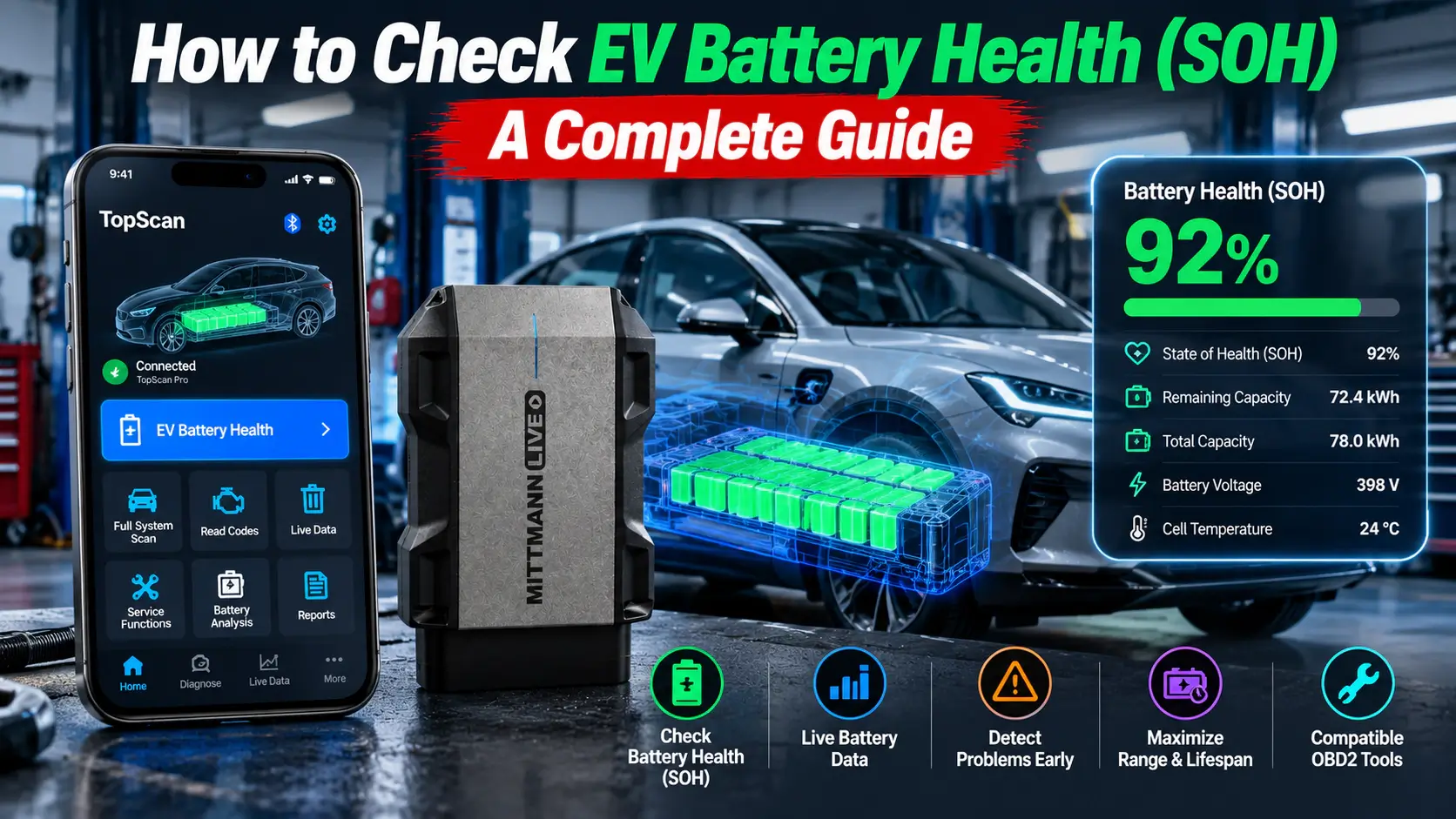
The high-voltage battery is the most expensive part of an electric car, and its condition decides what a used EV is really worth. The key number is State of Health (SOH) – how much capacity the battery still has compared to when it was new. This guide explains what SOH means, the ways to measure it, and what a professional battery check looks like in a workshop.
SOH vs SOC: what is the difference?
- SOC (State of Charge) – how full the battery is right now, in percent. It is the "fuel gauge".
- SOH (State of Health) – how much usable capacity the battery has left compared to new. A 60 kWh battery with 90% SOH can store about 54 kWh.
A car can show 100% SOC and still have a worn battery. That is why range alone is not a reliable health check.
What is a good SOH?
| SOH | What it usually means |
|---|
| 95–100% | Like new; typical for young, low-mileage cars |
| 85–95% | Normal aging; most used EVs are here |
| 75–85% | Noticeably reduced range; check cell balance and history |
| Below 75% | Check warranty terms; many manufacturers guarantee around 70% for 8 years |
Warranty thresholds and periods differ by manufacturer and market – always check the exact terms for the vehicle.
Four ways to check EV battery health
1. The car's own display or app
Some models show battery health in a menu or in the manufacturer app. It is free and easy, but many cars do not show it at all, and the value is often rounded or smoothed.
2. OBD2 dongle with an EV app
Some apps read the SOH value that the battery management system (BMS) calculates. Good for owners who want a quick look, but support depends heavily on the model, and you only see what the BMS reports – not why.
3. Professional EV diagnostic tool
A professional tool reads the BMS directly and shows SOC, SOH, capacity, and the voltage of every cell and module. That is the only way to see whether the battery is aging evenly or whether one module is pulling the whole pack down. It also reads fault codes in the high-voltage system, the charger, the inverter and the thermal management.
4. Capacity test (full charge and discharge)
The most accurate method measures the energy the battery actually delivers from full to empty under controlled conditions. It takes hours and is usually reserved for detailed assessments, warranty disputes or battery repair.
Why cell-level data matters
A pack with 88% SOH can be in perfect condition – or it can have one weak module that is close to failing. The BMS limits the whole pack to its weakest cells, so one bad module means less range, reduced charging power and, eventually, a fault.
What a technician looks for:
- Voltage spread between cells – a small difference is normal; a growing gap under load points to a weak cell or module
- Module temperatures – one module running hotter than the rest
- Insulation and HV fault codes – isolation faults, contactor faults, cooling system errors
- Charging history – where available, the share of DC fast charging and deep discharges
With this data, a workshop can often replace or balance a single module instead of the whole pack.
A professional battery check step by step
- Visual check and safety – only trained, HV-qualified staff with the right protective equipment work on high-voltage systems.
- Full-system scan – read fault codes in the BMS, charger, inverter, DC/DC converter and thermal system.
- Read battery data – SOC, SOH, capacity, cell and module voltages, temperatures.
- Compare cells – look for outliers and uneven aging.
- Load or drive test – check how cell voltages behave under load.
- Report – document the results for the customer, buyer or warranty claim.
Tool for workshops: Autel MaxiSys Ultra EV
For workshops that service electric and hybrid vehicles, the Autel MaxiSys Ultra EV is built for exactly this job:
- HV battery analysis at cell, module and pack level – SOC, SOH, cell voltages and capacity
- EV Diag Box and high-voltage adapters for in-depth battery work
- MaxiFlash VCMI – VCI, 4-channel oscilloscope, multimeter, waveform generator and CAN bus tester in one unit
- ECU coding and programming, J2534 and OE topology for conventional cars too
- 12.9-inch screen and HaynesPro technical information
It is one tool for EVs, plug-in hybrids and combustion cars – so the workshop does not need a separate EV system.
See all our EV diagnostic solutions.
Frequently asked questions
Can I check EV battery health myself?
You can read the SOH value that some cars show in their menu or app, or use an OBD2 app for supported models. A detailed check with cell data needs a professional EV diagnostic tool.
How often should battery health be checked?
Before buying or selling a used EV, before a warranty ends, and whenever range or charging speed drops suddenly.
Does fast charging damage the battery?
Frequent DC fast charging and keeping the battery at 100% for long periods speed up aging, especially in hot climates. Occasional fast charging is not a problem.
Does a low SOH mean the battery must be replaced?
Not always. If one module is the cause, a workshop can often replace or balance that module only. That is why cell-level data matters.
Conclusion
SOH tells you how much battery is left; cell data tells you why. For a quick look, the car's menu or an app may be enough. For buying decisions, warranty claims and repairs, a professional check with cell and module data is the only reliable answer.
View Autel MaxiSys Ultra EV